

(A Trade Article with cited references) Vocational Rehabilitation (VR) has traditionally been framed as a pathway to employment. While employment outcomes remain central, a growing body of medical, behavioral, and regulatory evidence demonstrates that VR provides far broader therapeutic value—particularly for individuals with serious mental illness (SMI) and intellectual/developmental disabilities (I/DD). When properly designed, VR functions not only as a work-readiness intervention, but also as a behavioral regulation tool, cognitive rehabilitation platform, and environmental adaptation strategy, especially within structured residential settings such as adult foster care.
Regulatory and Clinical Foundation of Vocational Rehabilitation…
From a regulatory perspective, VR is explicitly designed for individuals whose mental or physical impairments constitute a substantial impediment to employment, with federal policy presuming that such individuals can benefit from VR services tailored to their strengths and informed choice. The Rehabilitation Act further establishes VR as a comprehensive service model encompassing training, supports, assistive technology, and individualized planning to maximize functional outcomes. [ecfr.gov] [uscodeweb1.house.gov]
Clinically, VR is grounded in psychosocial rehabilitation and recovery-oriented care. Research shows that meaningful work is associated with enhanced self-esteem, improved mental health, social integration, and reduced stigma, making it a core component of recovery for people with mental illness. Even where employment outcomes vary, vocational interventions contribute to symptom improvement, functional gains, and community engagement. [psychology…rchnet.com] [pmc.ncbi.nlm.nih.gov]
VR as a Behavioral and Redirection Tool…
For individuals with SMI and I/DD, VR offers a structured, repeatable framework that supports behavioral stabilization and redirection:
- Structured routines: Engagement in scheduled vocational tasks reduces idle time, a known contributor to maladaptive behaviors.
- Goal-directed activity: Task completion reinforces executive functioning and impulse control.
- Positive reinforcement cycles: Immediate feedback in vocational settings helps shape adaptive behaviors.
SAMHSA guidance highlights that vocational engagement helps individuals establish healthy routines, improve self-esteem, and reduce maladaptive behaviors such as substance use or disengagement. These mechanisms translate directly into behavioral benefits in mental health and residential populations. [library.samhsa.gov]
Environmental Adaptation in Group Residential Settings…
In adult foster care and group homes, environmental monotony and limited stimulation can exacerbate behavioral symptoms. VR introduces purposeful environmental variation, which is critical for adaptive functioni
- Scenery change (community or simulated): Provides cognitive stimulation and reduces environmental stressors.
- Role differentiation: Individuals shift from “resident” to “participant,” reinforcing identity and autonomy.
- Skill generalization: Practicing tasks outside the residential context improves real-world functioning.
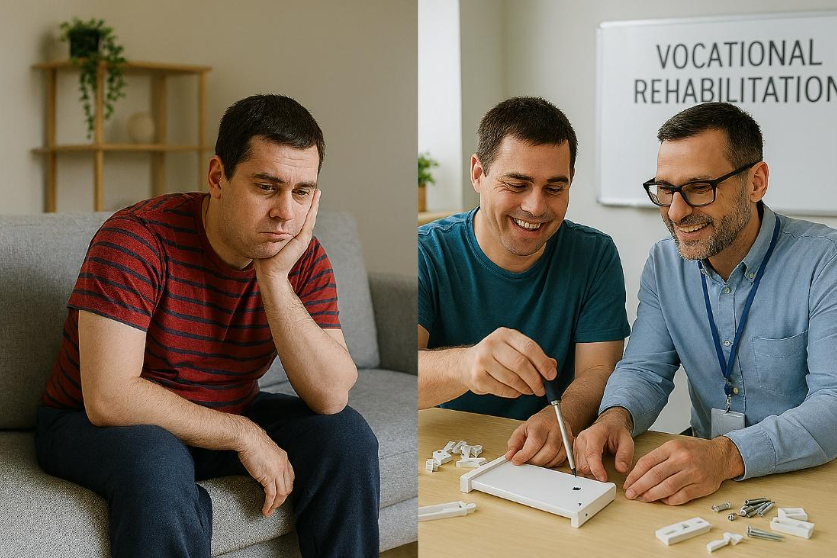
Residential care research underscores that structured programming is essential for individuals who struggle with core life skills and treatment adherence, with enriched environments improving outcomes. [link.springer.com]
The Emerging Role of Virtual Reality in Vocational Rehabilitation…
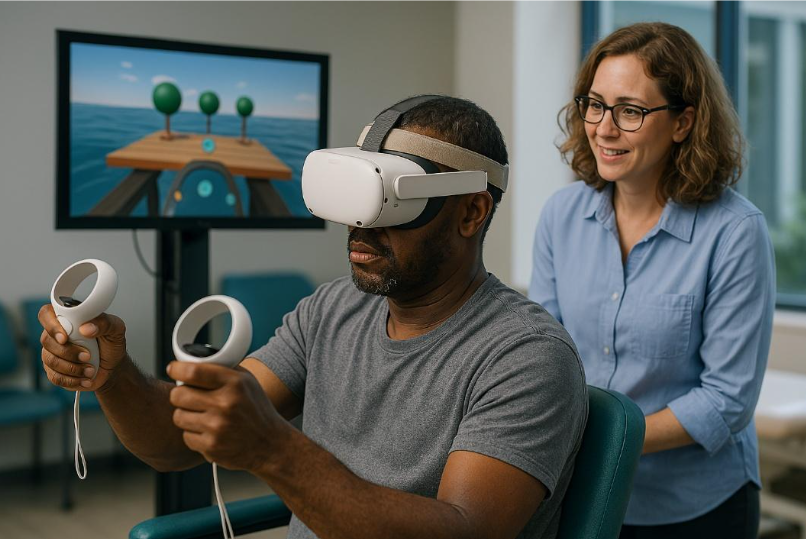
Virtual Reality (VR technology) significantly amplifies these effects by creating controlled yet immersive environments:
- VR allows individuals to practice vocational and social skills safely and repeatedly.
- Simulated environments enhance generalization of learned behaviors to real-world settings. [psych.theclinics.com]
- VR-based interventions show effectiveness across anxiety, depression, ADHD, and PTSD, indicating broad neuropsychiatric applicability. [frontiersin.org]
Importantly, VR also facilitates exposure-based learning, emotional regulation, and confidence building in ways that traditional environments cannot easily replicate. For individuals in restrictive residential settings, VR provides a meaningful “change of scenery” without logistical barriers, reducing agitation and promoting engagement.
Synergy with Neurological Cognitive Rehabilitation…
The integration of VR (vocational rehabilitation) with Neurological Cognitive Rehabilitation (NCR) yields particularly powerful results. Cognitive rehabilitation focuses on restoring or compensating for impairments in:
- Attention
- Memory
- Executive functioning
- Problem-solving
These domains are directly targeted through structured exercises that promote neuroplasticity and functional recovery. [pmc.ncbi.nlm.nih.gov]
Examples of Meaningful Neurocognitive Exercises in Vocational Contexts…
- Executive Function Training
- Task sequencing (e.g., completing multi-step work assignments)
- Goal setting and planning exercises
- Problem-solving scenarios during simulated job tasks
→ Enhances organization, self-monitoring, and behavioral control [theadultsp…rkbook.com]
- Memory Rehabilitation
- Use of checklists, schedules, and recall tasks tied to job routines
- Associative learning (e.g., linking tasks with cues or prompts)
→ Improves working memory and task retention [optoceutics.com]
- Attention and Processing Speed
- Timed sorting, matching, or assembly tasks
- Dual-task exercises (e.g., following instructions while working)
→ Strengthens sustained attention and cognitive flexibility
- Social Cognition and Behavioral Regulation
- Role-playing workplace interactions (live or VR-based)
- Emotional regulation exercises during task performance
→ Supports interpersonal functioning and reduces behavioral dysregulation
Cognitive rehabilitation has been shown to improve daily functional ability and reduce behavioral symptoms, particularly when interventions are individualized and goal-oriented. [pmc.ncbi.nlm.nih.gov]
Integrated Model: A Therapeutic Multiplier Effect…
When VR is combined with cognitive rehabilitation principles within residential settings, the result is a therapeutic multiplier effect:
| Component | Primary Impact | Secondary Gains |
| Vocational Rehabilitation | Structure, purpose, skill building | Confidence, identity formation |
| Cognitive Rehabilitation | Neurocognitive restoration | Behavioral regulation |
| VR Technology | Immersive learning, repetition | Generalization, engagement |
| Environmental Adaptation | Reduced monotony | Emotional stability |
Together, these elements produce enhanced neurobehavioral outcomes, including:
- Reduced agitation and maladaptive behaviors
- Improved executive functioning and emotional regulation
- Increased independence in activities of daily living
- Greater readiness for community integration
Let us summarize…
Vocational Rehabilitation is far more than a workforce development tool. For individuals with mental illness and developmental disabilities, it is a clinically meaningful intervention that supports behavioral stabilization, cognitive recovery, and environmental adaptation. In residential care settings, it offers a structured pathway to purpose while mitigating the limitations of institutional environments.
When enhanced with virtual reality technologies and grounded in cognitive rehabilitation principles, VR evolves into a dynamic, evidence-based therapeutic modality—one that not only prepares individuals for employment but actively reshapes behavior, cognition, and quality of life.

Another Blog Post by Direct Care Training & Resource Center, Inc. Photos used are designed to complement the written content. They do not imply a relationship with or endorsement by any individual nor entity and may belong to their respective copyright holders.
| Follow us in the Social Stratosphere… | ||||
|


