Could your facility survive a surprise state audit today if an inspector demanded to see your team’s current clinical credentials? For many administrators, the fear of non-compliance isn’t about a lack of care, but rather the logistical challenge of coordinating training for a large, rotating workforce. Obtaining the correct cpr certification for healthcare providers is more than a simple checkbox for your HR file; it’s a critical component of risk management and clinical excellence. You’ve likely felt the frustration of distinguishing between BLS and Heartsaver levels or the stress of ensuring every staff member meets the rigorous 2026 standards.
We understand that maintaining high-quality instruction while managing a facility is a high-stakes balancing act. This guide will help you master the current regulatory requirements and clinical standards to ensure your facility remains compliant and your team stays ready to save lives. We’ll examine the 2026 ILCOR updates, including the unified Chain of Survival and new opioid overdose algorithms. You’ll gain a clear roadmap for achieving a fully compliant workforce through streamlined on-site training that reduces liability and prioritizes professional standards.
Key Takeaways
- Identify how the 2026 ILCOR and AHA updates, including new opioid response algorithms, dictate modern clinical readiness standards.
- Distinguish between Basic Life Support (BLS) and Heartsaver courses to ensure your clinical staff holds the correct scope of practice.
- Navigate the complex regulatory landscape of cpr certification for healthcare providers to satisfy OSHA and state licensing requirements for hands-on skills verification.
- Compare hybrid and on-site training models to determine the most efficient way to maintain a fully compliant and life-save ready workforce.
- Learn how customized on-site training packages for CPR, First Aid, and Blood Borne Pathogens reduce facility liability and streamline team coordination.
Table of Contents
-
Understanding CPR Certification Standards for Modern Healthcare Providers
-
BLS vs. Heartsaver: Navigating Clinical Requirements and Scope of Practice
-
Beyond the Card: Regulatory Compliance and Risk Mitigation for Facilities
-
Implementation Strategies: On-Site Training vs. Hybrid Learning Models
Understanding CPR Certification Standards for Modern Healthcare Providers
Is your staff equipped with the skills to intervene during a cardiac event, or do they merely have a basic understanding of the steps? For clinical professionals, the distinction between a general awareness of life-saving measures and a formal cpr certification for healthcare providers is a matter of both patient safety and legal liability. While layperson courses focus on the basics of chest compressions, the healthcare provider (HCP) standard is a higher-tier clinical requirement. It demands mastery of high-quality chest compressions, advanced airway management, and the precise use of Automated External Defibrillators (AEDs) within a team environment. Professional licensure requires more than just knowing the steps; it requires a validated certification that proves clinical competency.
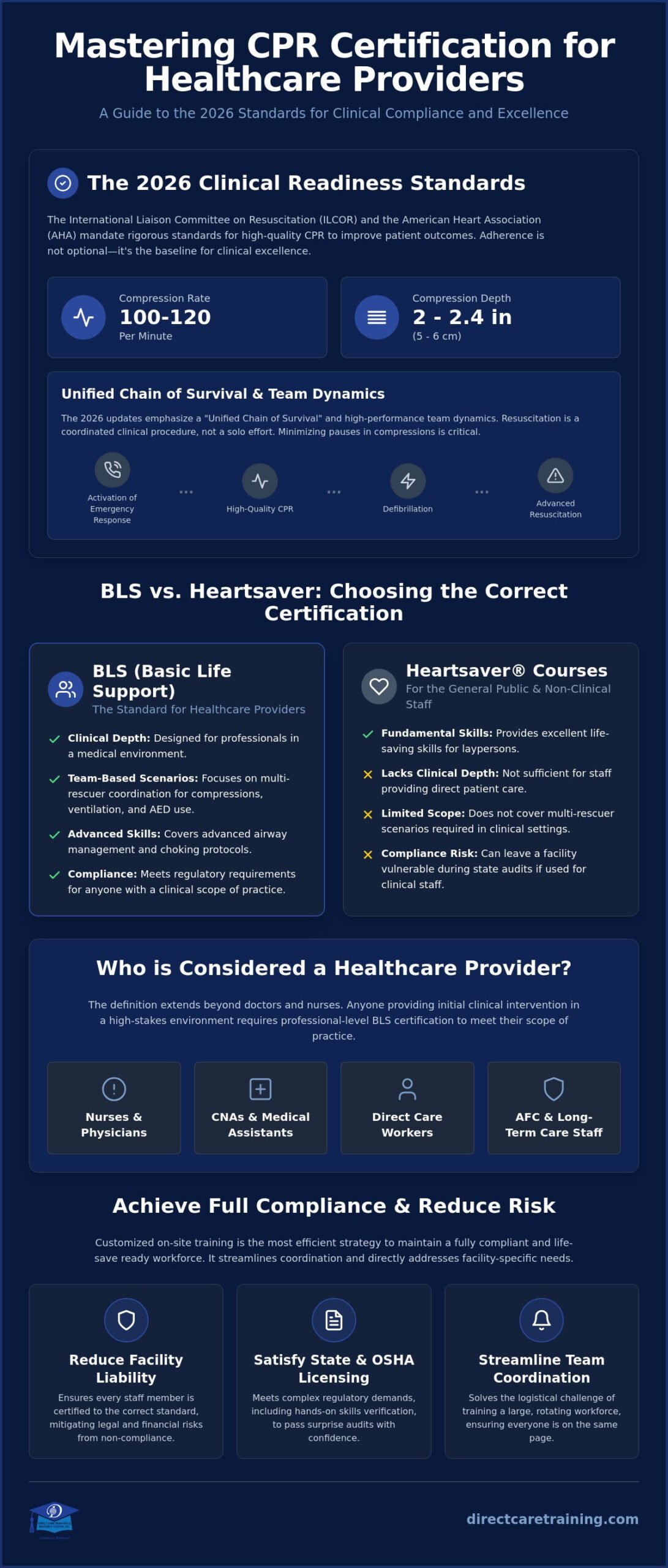
The International Liaison Committee on Resuscitation (ILCOR) and the American Heart Association (AHA) established rigorous 2026 guidelines that prioritize clinical precision. These standards mandate a compression rate of 100 to 120 per minute and a depth of at least 2 inches, but not exceeding 2.4 inches. Adhering to these benchmarks isn’t optional. It’s the baseline for ensuring blood flow to vital organs during a cardiac arrest. A failure to meet these specific metrics during an emergency can lead to poor patient outcomes and significant regulatory scrutiny for your facility.
The Evolution of Resuscitation Science in 2026
How has the science of saving lives changed this year? The 2026 updates emphasize high-performance team dynamics and a "Unified Chain of Survival" that applies across all cardiac arrest situations. Resuscitation is no longer viewed as a solo effort but as a coordinated clinical procedure. There’s a renewed focus on minimizing pauses in compressions. Even a ten-second interruption can significantly decrease the chances of a successful outcome. Modern training now integrates real-world scenarios like opioid overdose response and choking protocols to ensure your team is ready for the specific emergencies they’ll face on the floor.
Who Qualifies as a Healthcare Provider?
Who exactly needs this level of training? While nurses and physicians are the obvious candidates, the definition extends to anyone working in a high-stakes clinical or residential environment. This includes CNAs, medical assistants, and direct care workers. In Michigan, staff in Adult Foster Care (AFC) and long-term care facilities are often categorized similarly to a Certified First Responder because they provide the initial clinical intervention during a crisis. Choosing a layperson course instead of a dedicated cpr certification for healthcare providers can leave your facility vulnerable during state audits. More importantly, it leaves your staff unprepared for the complexities of a real-world cardiac arrest. Professional standards require professional training. To see how premier providers empower organizations through comprehensive educational programs, check out Trainetics Academy.
BLS vs. Heartsaver: Navigating Clinical Requirements and Scope of Practice
Are you certain your staff holds the correct credential for their specific duties? Choosing the wrong level isn’t just a training error; it’s a compliance failure that can jeopardize your facility’s license. While many people use the terms "CPR" and "BLS" interchangeably, the distinction is vital for regulatory adherence. Basic Life Support (BLS) serves as the non-negotiable baseline for anyone providing direct patient care. While Heartsaver courses provide excellent life-saving skills for the general public, they lack the clinical depth required for a professional medical environment. The primary differentiator lies in the complexity of multi-rescuer scenarios. In a clinical setting, resuscitation is rarely a solo task. A cpr certification for healthcare providers prepares your team to work in tandem, managing compressions, ventilation, and AED operation simultaneously without losing critical seconds.
Your staff’s "Scope of Practice" is the ultimate guide for which certification they must hold. If an employee is legally permitted to perform medical assessments or administer treatment, a layperson-level course will not suffice during an audit. Regulatory bodies expect clinical personnel to be trained in advanced techniques that reflect their professional responsibilities. For those managing complex environments, scheduling on-site safety courses ensures that every team member receives the specific training level required by their job description.
Deep Dive into Basic Life Support (BLS)
BLS training involves advanced assessment techniques that go beyond simple observation. Clinicians must master rapid pulse and breathing checks to determine the next steps in a resuscitation algorithm. This includes the proficient use of bag-mask valves for ventilation, a skill not found in layperson programs. Following the course provided by Direct Care Training can supply the needed knowledge and insight for these necessary life-saving decision-making skills .
When is Heartsaver Sufficient?
When is a lower-tier certification appropriate? Heartsaver First Aid and CPR is generally sufficient for administrative staff, maintenance crews, or non-direct care roles where the legal scope of practice doesn’t mandate clinical intervention. Some facilities utilize Heartsaver as a universal baseline for all personnel, ensuring that even the receptionist can initiate the Chain of Survival before the clinical team arrives. However, you must verify state-specific licensing requirements, as some Adult Foster Care regulations may require a cpr certification for healthcare providers even for certain non-clinical roles to maintain a higher standard of readiness.
Beyond the Card: Regulatory Compliance and Risk Mitigation for Facilities
Have you ever been tempted by an advertisement for a "15-minute online CPR" course? While the low price and convenience are appealing, these programs are often a fast track to a failed state audit. OSHA and state licensing boards generally reject certifications that lack a documented hands-on skills assessment. For a valid cpr certification for healthcare providers, an instructor must witness the staff member performing high-quality compressions and proper ventilation on a manikin. Without this physical verification, your team isn’t just uncertified in the eyes of the law; they’re a significant liability risk. During a sentinel event, investigators will look past the certificate to see if the training met the rigorous 2026 clinical standards. If it didn’t, the facility bears the legal weight of that negligence.
Compliance isn’t just about safety; it’s about the financial and operational health of your organization. Adherence to recognized training standards is a prerequisite for Medicaid and Medicaid Waiver enrollment. If your documentation is flawed or your staff credentials don’t meet the HCP-tier requirements, your facility’s funding and licensure could be at risk. It’s a high-stakes environment where "good enough" training can lead to catastrophic professional consequences.
Audit Readiness and Certification Tracking
How do you manage fifty different expiration dates without a single one slipping through the cracks? A single uncertified staff member on shift during a state inspection can trigger a "Type A" violation or a heavy fine. We recommend a dual-layer tracking system. Maintain a digital repository of eCards for instant access during audits, but keep physical copies in employee files as a backup. This level of organization proves to auditors that your facility prioritizes a culture of readiness. Tracking shouldn’t be a reactive scramble; it should be a proactive administrative habit.
Mitigating Professional Liability
High-quality training serves as your most effective legal defense. When a cardiac arrest occurs, the facility’s response is scrutinized by families, lawyers, and regulators alike. Did the staff follow the 2026 algorithms? Programs like what Direct Care Training offers provide a rigorous foundation that builds genuine staff confidence. This confidence translates to better patient outcomes and reduced liability. To further protect the facility, ensure that CPR training is complemented by other specialized instruction, such as proper medication handling, to create a comprehensive safety net for your residents and your business.
Implementation Strategies: On-Site Training vs. Hybrid Learning Models
How do you coordinate training for a rotating staff without leaving your floor short-handed? Selecting the right delivery model for cpr certification for healthcare providers is a logistical decision that directly impacts your facility’s operational efficiency. While traditional classroom settings offer a focused environment, they often require staff to travel off-site. This adds hidden costs in travel time, mileage, and the need for coverage while they are away. Conversely, the "Blended Learning" model has become a dominant trend in 2026. This hybrid approach allows employees to complete cognitive training online at their own pace before attending a brief, in-person skills session. It is a flexible solution, but it requires a high degree of staff discipline to ensure the online portion is finished before the instructor arrives for the hands-on check.
For most long-term care and specialized facilities, on-site training remains the most effective strategy. By bringing the instructor to your location, you ensure the training environment perfectly mimics the actual care setting where emergencies will occur. Staff can practice with the specific AED models and bag-mask valves they use daily. This familiarity reduces hesitation during a real-world cardiac event. Group-based sessions also allow for team-wide coordination, which is a core requirement of the 2026 BLS standards. To streamline your compliance efforts and ensure your team is fully prepared, you can schedule on-site CPR and safety training to minimize staff downtime and maximize clinical readiness.
The Logistics of On-Site Facility Training
On-site sessions provide the unique benefit of customized feedback. A lead instructor can observe how your team moves within your specific facility layout, identifying potential bottlenecks in emergency response. Scheduling these sessions in groups allows you to train entire shifts at once, which is far more efficient than tracking individual classroom completions. It ensures that everyone on a particular floor is operating under the same set of 2026 resuscitation protocols, creating a more cohesive and reliable response team. Professional training sites such as Heartbeat Heroes utilize this approach to help facilities maintain the highest standards of clinical readiness.
Integrating Bloodborne Pathogen Safety
Is your team prepared for the biohazards present during a resuscitation attempt? Integrating Bloodborne Pathogen (BBP) safety into your curriculum is not just a best practice; it is an OSHA requirement. While a cpr certification for healthcare providers typically remains valid for two years, OSHA mandates that BBP training be updated annually. This discrepancy often leads to compliance gaps if not managed carefully. Effective training must cover the practical application of personal protective equipment (PPE) and biohazard disposal while the team is actively performing life-saving measures. Ensuring your staff understands how to handle biohazards during the chaos of an emergency is a critical component of professional risk mitigation.
Elevating Care Standards with Direct Care Training Programs
Are you satisfied with a training provider that simply checks a box, or do you require a partner who understands the high-stakes nature of specialized care? Direct Care Training & Resource Center Inc acts as an authoritative mentor for facilities that can’t afford the risk of non-compliance. We provide the cpr certification for healthcare providers your team needs while simultaneously addressing the administrative hurdles that keep administrators awake at night. Our on-site packages for CPR, First Aid, and Bloodborne Pathogens are specifically designed for the unique rhythms of adult foster care and nursing home environments. We don’t just deliver a curriculum; we deliver a safeguard against liability.
Our approach blends clinical rigor with practical helpfulness. By choosing a partner that understands Michigan AFC and national Medicaid standards, you’re investing in more than just a training session. You’re gaining a consultant who knows the pitfalls of state audits and the nuances of clinical readiness. This expert-led atmosphere reassures your staff that they’re receiving the highest level of industry knowledge available. We take pride in the quality of our resources and remain deeply committed to the success of our partners in the long-term care sector.
Comprehensive Safety and Compliance Solutions
What other risks are hiding in your operational workflow? Our expertise extends far beyond resuscitation science. We provide specialized training in medication handling and mandated human trafficking and implicit bias sessions. For those in the early stages of facility management, we offer expert guidance through Michigan AFC prelicensing preparation and digital guides for Medicaid and Medicaid Waiver enrollment. We even develop customized training manuals for unique settings like juvenile detention facilities. This breadth of support ensures that every aspect of your facility’s safety and regulatory standing is reinforced by veteran industry knowledge. It’s about building a comprehensive safety net that protects your residents and your professional reputation.
Starting Your Facility Readiness Plan
How can you begin transforming your facility’s approach to safety today? A robust readiness plan starts with a consultation that identifies your specific gaps in training and compliance. When you invest in expert-led instruction, the impact extends beyond a successful audit. It significantly improves staff morale and retention, as employees feel more competent and valued when provided with high-quality professional development. A team that knows they can handle a crisis is a team that stays. Our CPR and First Aid training resources are designed to foster this environment of excellence. Ensure your team is ready-contact Direct Care Training today .
Securing Your Facility’s Clinical Future
Maintaining a state of readiness is a continuous commitment to both patient safety and regulatory excellence. The 2026 standards demand more than a simple understanding of resuscitation; they require a high-performance team dynamic and precise clinical execution. Distinguishing between BLS and Heartsaver levels is no longer just a training preference; it’s a critical factor in mitigating professional liability and ensuring your facility meets Medicaid enrollment standards.
Achieving a valid cpr certification for healthcare providers requires a strategic partner who understands the specific pressures of long-term care and adult foster care environments. Direct Care Training provides the expert guidance necessary to navigate these complexities through on-site clinical safety courses and comprehensive consulting packages. You don’t have to leave your compliance to chance or let a single lapsed card jeopardize your licensure during a state inspection.
Schedule Professional On-Site CPR Training for Your Facility to ensure your team is equipped with the skills and confidence to act when seconds count. We’re here to help you build a safer, more resilient care environment for your residents and your staff. Your commitment to high standards today is the best safeguard for your facility’s future.
Frequently Asked Questions
Is online-only CPR certification acceptable for healthcare providers?
No, online-only certifications are generally rejected by OSHA and state licensing boards because they lack a documented hands-on skills assessment. For a valid cpr certification for healthcare providers, an instructor must physically verify your technique on a manikin. While you can complete the cognitive theory through a computer, the certification is only issued after a successful demonstration of high-quality compressions and ventilation.
How often do healthcare providers need to renew their CPR certification?
Most professional certifications from recognized bodies like the American Heart Association are valid for two years. However, you should check your specific facility’s policy or state regulations, as some high-acuity environments require more frequent skills refreshers. Maintaining a proactive tracking system ensures no staff member falls into a non-compliant "lapsed" status, which can trigger immediate violations during a state inspection.
What is the difference between ACLS and BLS for healthcare workers?
Basic Life Support (BLS) focuses on the foundational skills of high-quality CPR, AED use, and team-based resuscitation. Advanced Cardiovascular Life Support (ACLS) builds upon that foundation by adding advanced airway management, ECG rhythm recognition, and the administration of emergency medications. While all clinical staff need BLS, ACLS is typically required for those working in critical care, emergency departments, or surgical suites.
Does CPR certification for healthcare providers include First Aid?
Standard BLS courses typically focus strictly on cardiac and respiratory arrest scenarios and do not automatically include First Aid. First Aid is often a separate module or a combined training package. For comprehensive facility compliance, many administrators choose to bundle cpr certification for healthcare providers with First Aid and Bloodborne Pathogens training to ensure the team is ready for all emergency types.
What happens if a healthcare provider’s CPR certification lapses?
A lapsed certification immediately disqualifies a provider from providing direct patient care under most state licensing and OSHA regulations. From a facility perspective, allowing staff to work with expired credentials creates a massive liability risk and can lead to severe fines. It’s safer to pull a staff member from the floor than to risk a sentinel event occurring while an uncertified responder is on duty.
Are there specific CPR requirements for Medicaid Waiver providers?
Yes, Medicaid Waiver programs often have strict provider qualifications that mandate a specific level of clinical training. These regulations frequently specify that the training must include a hands-on component and be tailored to the healthcare professional level. Using a layperson "Heartsaver" course instead of an HCP-tier certification may not satisfy the audit requirements for these specialized and highly regulated funding streams.
Can a facility host its own on-site CPR training for all staff?
Hosting on-site training is often the most cost-effective way to ensure total team compliance and operational readiness. It allows your staff to learn in their actual work environment using the equipment they handle daily. This approach minimizes downtime and allows the instructor to tailor resuscitation scenarios to your facility’s specific layout and the unique needs of your resident population.
What is the "skills check" portion of a hybrid CPR course?
The skills check is the mandatory in-person portion of a hybrid or "blended" learning course. After you complete the online cognitive modules, you must meet with a certified instructor to demonstrate proficiency in chest compressions, bag-mask ventilation, and AED operation. This physical verification is the only way to make the certification legally valid for professional clinical practice and regulatory audits.