
Could your vision for a new care facility be derailed by a single misunderstanding of the Bureau of Community and Health Systems (BCHS) bureaucracy? Most prospective providers view the state’s application process as a series of tedious administrative hurdles, but the reality is that Michigan adult foster care licensing requirements are now a rigorous clinical standard designed to safeguard vulnerable residents. With the implementation of the consolidated Rule Set 2023-71 LR, the margin for error during inspections has narrowed significantly. It’s natural to feel a sense of urgency or even fear regarding the pre-licensure inspection, especially when staff training mandates and record retention rules seem to be in constant flux.
We recognize that you’re looking for a path through the red tape that doesn’t compromise your commitment to resident safety. This expert-led guide promises to help you master the complex regulatory landscape by providing a definitive breakdown of the 2026 requirements, staffing mandates, and inspection protocols. We’ll provide a clear understanding of the updated license categories and a checklist for physical plant safety to ensure you’re prepared for every LARA evaluator. You’ll gain the confidence needed to pass your pre-licensure orientation and establish a facility that meets the highest professional standards.
Key Takeaways
- Understand how the consolidated Rule Set 2023-71 LR streamlines administrative tasks while maintaining high clinical standards.
- Identify the specific BCAL forms and 2026 fee structures required to advance your application through the BCHS bureaucracy.
- Implement essential fire safety and zoning protocols to ensure your physical plant meets Michigan’s rigorous environmental standards.
- Master the mandatory Michigan adult foster care licensing requirements for direct care staff, including CPR, First Aid, and competency training.
- Gain the tools necessary to pass your pre-licensure orientation by addressing common inspection pitfalls before the state consultant arrives.
Table of Contents
-
Understanding the Framework of Michigan Adult Foster Care Licensing
-
Succeeding at the Pre-Licensure Orientation and Final Inspection
Understanding the Framework of Michigan Adult Foster Care Licensing
Do you understand the legal foundation of your future care business? Under Michigan law, Adult Foster Care (AFC) is defined as a residential setting providing 24-hour personal care, protection, and supervision for adults who are aged, mentally ill, developmentally disabled, or physically handicapped. It’s not merely a housing arrangement; it’s a strictly regulated clinical and social environment. The Department of Licensing and Regulatory Affairs (LARA), specifically the Bureau of Community and Health Systems (BCHS), acts as the primary gatekeeper. They ensure every provider meets the Michigan adult foster care licensing requirements before a single resident moves in. Compliance isn’t a suggestion. It’s a non-negotiable business foundation that protects your investment from legal liability and state intervention.
The BCHS oversight process is designed to be rigorous. With the 2026 implementation of the consolidated Rule Set 2023-71 LR, the state has simplified the administrative language while intensifying the focus on operational safety. You’re entering a landscape where clinical standards and administrative ethics are scrutinized during every inspection. Failing to treat these rules as a mandatory clinical standard is the fastest way to face license denial or forced closure.
License Categories: Family vs. Group Homes
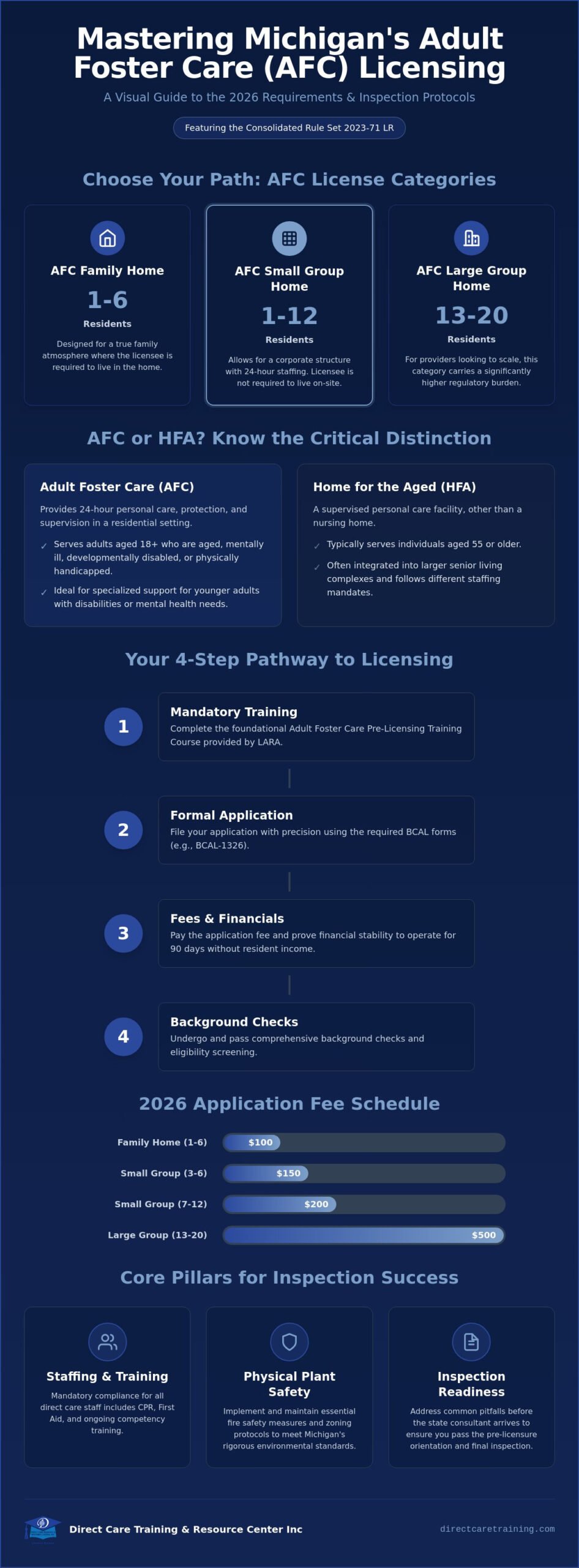
Choosing the right license category is your first strategic decision. Michigan offers three primary paths for entrepreneurs. First, the AFC Family Home is designed for 1 to 6 residents. In this model, the licensee must live in the home, creating a true family atmosphere. If you prefer a more corporate or detached structure, the AFC Small Group Home allows for 1 to 12 residents with 24-hour staffing, and you aren’t required to live on-site. For those looking to scale, the AFC Large Group Home accommodates 13 to 20 residents. This category carries a significantly higher regulatory burden, particularly regarding fire safety and staffing ratios. Understanding this Group Home Overview is essential for deciding which model aligns with your financial goals and care capacity.
The Legal Distinction Between AFC and Homes for the Aged (HFA)
Are you confused about whether you need an AFC or a Home for the Aged (HFA) license? The distinction is critical. AFC facilities generally serve adults aged 18 and older who need personal care and supervision. In contrast, HFAs typically serve individuals aged 55 or older. While both provide personal care, the HFA model is often integrated into larger senior living complexes and follows different staffing mandates. If your care philosophy focuses on specialized support for younger adults with disabilities or mental health needs, the AFC route is your path. Meeting the Michigan adult foster care licensing requirements starts with selecting the correct legal designation for your facility’s mission.
Step-by-Step Application Process for Michigan AFC Licensees
Are you prepared to move from the planning phase to formal state scrutiny? The process begins with the mandatory Adult Foster Care Pre-Licensing Training Course provided by LARA. This isn’t a casual webinar; it’s a foundational requirement that introduces you to the Bureau of Community and Health Systems (BCHS) expectations. Once this orientation is complete, you’ll file your formal application using the required BCAL forms, specifically the BCAL-1326. This stage requires precision. Any discrepancy in your paperwork can lead to immediate delays or even application denial. To navigate these hurdles effectively, many prospective owners utilize Michigan AFC prelicensing prep to ensure their documentation is audit-ready before submission.
The 2026 application fee schedule is based on your facility’s capacity. For a Family Home (up to 6 residents), the fee is $100.00. Small Group Homes incur a fee of $150.00 for 3 to 6 residents or $200.00 for 7 to 12 residents. Large Group Homes catering to 13 to 20 residents require a $500.00 application fee. Beyond the checkbook, you must prove financial stability. LARA requires evidence that your facility can remain fully operational for the first 90 days without a single dollar of resident income. This ensures that resident care is never compromised by a provider’s initial cash flow challenges.
Background Checks and Eligibility Screening
Do you and your team meet the state’s "Good Moral Character" standard? Every applicant, licensee designee, and administrator must undergo rigorous fingerprinting through the Michigan Long Term Care Background Check System (MILTCBC). Disqualifying offenses, including certain felonies or history of abuse, will permanently prevent you from holding a license. This requirement extends to any staff member or volunteer who has unsupervised access to residents. It’s a non-negotiable safeguard that the state uses to vet the integrity of the care workforce.
Financial and Operational Documentation
Your application is only as strong as your supporting documentation. You must draft a comprehensive Program Statement that defines exactly who you intend to serve and what specialized care you’ll provide. This document must align with your Admission Agreement and your Refund Policy. These contracts are legal shields for both you and your residents. They must clearly outline the services included in the monthly rate and the specific conditions under which a resident might be discharged. Proving you have a viable budget and a documented care philosophy is a central pillar of Michigan adult foster care licensing requirements.
Beyond licensing, establishing a robust administrative framework often includes planning for employee benefits; you can find out more about how 3(16) fiduciary services help business owners manage retirement plan compliance effectively.
Physical Plant and Environmental Safety Requirements
Is your chosen location legally permissible for care? Before signing a lease or purchasing a property, you must secure zoning approval. For many small group homes, Michigan law protects the right to operate in residential zones, but larger facilities often face stricter municipal scrutiny. Navigating these local ordinances is a critical first step in meeting the Michigan adult foster care licensing requirements. Once zoning is cleared, the focus shifts to the physical plant’s safety infrastructure. You cannot compromise on fire safety. This includes installing interconnected smoke detection systems, maintaining accessible egress routes, and ensuring fire extinguishers are placed according to state fire marshal codes.
Ongoing compliance is just as vital as the initial setup. The state requires rigorous documentation of safety protocols, including monthly fire drills. To safeguard your license, many providers opt for professional Monthly Fire Drill Supervision. This service ensures that drills are conducted correctly, timed accurately, and recorded in a format that satisfies BCHS consultants during unannounced inspections. Additionally, environmental health clearances for water quality, sewage disposal, and lead paint for older structures are mandatory. If your facility uses a private well, you’ll need regular nitrate and coliform testing to remain in good standing.
Resident Bedroom and Living Space Standards
Do your resident rooms meet the minimum square footage mandates? In Michigan, a single-occupancy bedroom must provide at least 80 square feet of usable floor space. For double occupancy, that requirement increases to 130 square feet. It’s not just about the floor; ventilation and light are equally important. Every bedroom must have at least one window that meets egress specifications for emergency exits. Each resident must also have access to specific furniture, including a comfortable bed, a chair, and adequate storage space for personal belongings. These standards ensure that your facility provides a dignified, home-like environment rather than a clinical ward.
Common Areas and Accessibility
How much space is dedicated to community life? Michigan rules mandate a ratio of 35 square feet of indoor living and dining space per resident. This prevents overcrowding and ensures that residents can move freely. Sanitation is another high-stakes area. You must maintain a bathroom-to-resident ratio that prevents long wait times and promotes hygiene. For facilities serving individuals with physical disabilities, ADA compliance and barrier-free design are mandatory. This includes ramps, widened doorways, and grab bars in bathrooms. If you’re targeting specialized care populations, your physical plant must reflect their specific mobility needs from day one.
Staffing Standards and Mandatory Training Compliance
Are your employees legally ready to provide care? In a Michigan AFC setting, a Direct Care Worker (DCW) is defined as any staff member providing care, protection, and supervision to residents. These individuals are the primary line of defense for resident safety, but they can’t work unsupervised until they meet specific competency standards. Under the consolidated Michigan adult foster care licensing requirements, every DCW must receive training in reporting requirements, resident rights, personal care, and food safety. While routine TB testing was eliminated in 2026 to align with CDC guidance, the burden of proving staff competency remains firmly on the licensee.
Documentation is your greatest safeguard against administrative citations. You must maintain a compliant personnel file for every employee, including background check clearances and training certificates. Michigan now enforces a uniform record-retention standard of two years for all licensing-related documentation. If a BCHS consultant finds a staff member on the floor without a verified training record, your license is at immediate risk. To ensure your team meets every state mandate without the hassle of off-site scheduling, consider our comprehensive adult foster care direct care worker training solutions.
Core Safety Certifications: CPR, First Aid, and Beyond
Why is on-site safety training considered the industry gold standard? While online modules provide theory, hands-on CPR and First Aid training ensure your team can respond to a life-threatening crisis with muscle memory. Your staff must also be trained in Bloodborne Pathogen safety to meet both OSHA and LARA standards. Perhaps the most critical area is medication management. Improper medication handling is the leading cause of licensing citations in Michigan. Your training curriculum must verify that every staff member understands the "six rights" of medication administration and the proper documentation of Medication Administration Records (MARs). To ensure your team meets the rigorous 2026 standards, review the complete requirements outlined in our guide to CPR certification for healthcare providers, which covers BLS levels, ILCOR updates, and clinical readiness benchmarks.
Advanced Training: Human Trafficking and Implicit Bias
Are you keeping up with Michigan’s newest training pillars? As of 2026, awareness of human trafficking and implicit bias is no longer optional; it’s a core component of professional care standards. These topics address the ethical and social complexities of modern healthcare. Additionally, if your facility serves specialized populations like those with dementia or severe mental health challenges, you must provide advanced training tailored to those specific needs. This ensures your staff can manage complex behaviors while maintaining a safe, therapeutic environment for everyone in the home.
Succeeding at the Pre-Licensure Orientation and Final Inspection
Are you prepared for the final hurdle of the BCHS licensing process? The pre-licensure orientation is the culmination of your application journey. It isn’t a casual meeting; it’s a comprehensive evaluation of your facility’s readiness to meet every Michigan adult foster care licensing requirements. During this on-site visit, a LARA licensing consultant will verify that your physical plant, staffing records, and operational policies align perfectly with state law. If your documentation is disorganized or your safety equipment is faulty, your license issuance will be delayed or denied.
Many applicants find this final "test" overwhelming. Utilizing specialized Michigan AFC prelicensing prep services can significantly reduce anxiety and the risk of a failed inspection. These services provide a second set of expert eyes to identify gaps before the state arrives. Once you pass this inspection, LARA will issue a temporary license. This is a six-month probationary period. During these first six months, you’ll receive at least one unannounced visit to ensure that your daily operations match the high standards you demonstrated during the initial orientation.
Common Inspection Deficiencies and How to Avoid Them
What are the most frequent reasons for a delayed license? Documentation gaps are the primary culprit. In the eyes of a BCHS inspector, if a procedure, fire drill, or training session wasn’t written down, it didn’t happen. Physical plant oversights, such as water temperatures exceeding 120 degrees Fahrenheit or malfunctioning fire doors, are also common red flags. You must also ensure every staffing file contains a verified background check clearance from the MILTCBC system. A single missing fingerprint result can halt your progress immediately. Reviewing these areas before the consultant arrives is the only way to safeguard your business launch.
Final Readiness: The Direct Care Training & Resource Center Inc Approach
How can you ensure your team is truly prepared for the first day of resident care? The Direct Care Training & Resource Center Inc approach emphasizes specialized healthcare training courses that go beyond basic compliance. Conducting a mock audit is one of the most effective ways to close the loop on your preparation. By simulating the LARA visit, you can identify and correct errors in a low-stakes environment. This transition from applicant to licensed provider requires a commitment to clinical excellence and administrative precision. When you treat the inspection as a clinical standard rather than an administrative hurdle, you position your facility for long-term success and resident safety.
Launching Your Licensed AFC Facility with Confidence
Building a successful care business in Michigan requires more than just a passion for helping others. It demands a rigorous commitment to operational excellence. You’ve learned that mastering Michigan adult foster care licensing requirements involves navigating complex zoning laws, maintaining strict physical plant safety, and ensuring your team is fully competent before they ever step onto the floor. Whether you’re managing a small family home or a large group facility, your ability to document every safety drill and training session will determine your standing with LARA.
Don’t let administrative oversights or training gaps jeopardize your mission. We provide the expert guidance and specialized resources necessary to move from the application phase to a fully licensed operation. Secure your facility’s future with Michigan AFC Prelicensing Prep from Direct Care Training . With our expert Michigan AFC regulatory consulting, comprehensive DCW training programs, and on-site safety certification for LTC facilities, you can approach your final inspection with absolute certainty. Your journey toward providing high-quality care starts with the right foundation. We’re ready to help you succeed.
Frequently Asked Questions
How long does it take to get an AFC license in Michigan?
The typical timeframe to obtain an Adult Foster Care license is between six and nine months. This duration depends on how quickly you complete the mandatory LARA orientation and the current workload of the Bureau of Community and Health Systems (BCHS) consultants. Ensuring your physical plant is ready for inspection before submitting your final application can prevent unnecessary delays in the process.
What is the difference between an AFC and a Nursing Home?
Adult Foster Care facilities provide personal care, protection, and supervision in a residential setting, while nursing homes provide 24-hour skilled medical care. AFCs focus on assisting with activities of daily living and social support for adults who don’t require constant nursing intervention. Nursing homes are clinical environments designed for individuals with complex medical needs that necessitate licensed medical professionals on-site at all times.
Can I open an Adult Foster Care home in my own residence?
Yes, you can operate an AFC Family Home within your primary residence for up to six residents. Under this license category, the licensee must live on-site and act as the primary caregiver. This model is often preferred by those who wish to provide a highly personalized, home-like atmosphere while meeting all state safety and operational standards.
How much are the Michigan AFC licensing fees in 2026?
The 2026 fee schedule is based on the size and type of your facility. A Family Home license costs $100.00, while Small Group Homes are charged $150.00 for up to six residents or $200.00 for seven to 12 residents. Large Group Homes with a capacity for 13 to 20 residents require a $500.00 application fee. These fees are non-refundable and must be paid when you submit your formal BCAL application forms.
What are the staffing ratios for a Michigan AFC small group home?
Michigan law requires a minimum staffing ratio of one direct care worker for every 12 residents. It’s important to remember that this is a baseline requirement. Your specific Program Statement must outline a staffing plan that safely meets the clinical and behavioral needs of your residents, which often requires higher staffing levels than the state minimum during daytime hours.
Is CPR and First Aid training required for all AFC employees?
Yes, every direct care staff member must be trained and certified in CPR and First Aid before they can work independently with residents. This mandate is a core component of Michigan adult foster care licensing requirements designed to ensure immediate response during medical emergencies. Documentation of these certifications must be maintained in each employee’s personnel file for inspection by LARA consultants. Understanding the full scope of CPR certification for healthcare providers under the 2026 standards can help you ensure your staff meets every clinical and regulatory benchmark.
What happens if I fail my initial Michigan AFC inspection?
If your facility doesn’t meet state standards during the initial visit, the licensing consultant will issue a report detailing the specific deficiencies. You’ll be required to submit a Corrective Action Plan (CAP) that outlines how you’ll fix each violation. Once the BCHS reviews and accepts your plan, a follow-up inspection is scheduled to verify that your facility is fully compliant before the temporary license is issued.
Do I need a medical background to own an Adult Foster Care home?
You don’t need a medical degree or nursing license to own or operate an AFC, but you must demonstrate professional competency. The state requires licensees and administrators to be proficient in financial management, resident rights, nutrition, and medication administration. While a medical background is helpful, the focus of the Michigan adult foster care licensing requirements is on your ability to provide a safe, supervised, and well-managed residential environment.